
Studies we support
Explore the MS research studies we fund and endorse, and see how each project improves understanding, treatment and support for people living with multiple sclerosis.
MS Trust has awarded a grant to researchers at the University of Sheffield and Sheffield Teaching Hospitals NHS Foundation Trust to study the use of mobility sensors for people living with progressive multiple sclerosis (MS). The research team wants to see if these sensors can be used to monitor how well people walk in their homes and community. They hope that this will both help them and their doctors to manage their multiple sclerosis and could be used in testing new treatments for MS. At the moment, doctors are only able to check walking for a short while when people come to the hospital for their clinic appointments.
People with MS report that being able to walk well is one of the most important aspects of their daily activities and health. Many people in the public may take the ability to walk for granted, but having this taken away affects both physical and mental health. Unfortunately, walking is affected for approximately 90% of people with MS, and 76% of people with MS will require a walking aid at some point.
Project Team leads: Drs Gavin Brittain & Ellen Buckley; Drs David Paling, Tecla Bonci and Professors Basil Sharrack, Vitaveska Lanfranchi, Krishnan Padmakuman Sivaraman Nair (Sheffield) and Dr Linford Fernandes and Professor Helen Ford (Leeds).
Walking can gradually get worse over time, even in people with MS who are not having relapses. Monitoring how a person walks in their everyday life using a wearable device could be utilised to track MS progression and how well treatments work over time.
Led by Drs Gavin Brittain and Ellen Buckley, the study will use wearable devices to measure walking and movement in people with progressive MS. It will, therefore, focus on measuring walking while a person is in their own home and in the community, doing their usual, day-to-day activities. This approach allows researchers to assess a person’s ability to walk accurately and how this affects their daily life. A total of 46 people with progressive MS have now been recruited across Sheffield and Leeds out of the proposed cohort of 50.
The study aims to find improvements to current methods for measuring walking in people with progressive MS by recording their mobility during everyday activities rather than limited to a hospital setting.
The most common current test to measure how severe someone’s MS is called the Expanded Disability Status Scale (EDSS) which is commonly used in clinical trials. The problem with this measurement is that it can only be measured when people come to the hospital, and even then, it is not able to detect quite large changes to someone’s ability to walk. The sensors in the study will monitor various aspects of walking accurately and remotely from people’s homes, and are more able to detect more minor changes in someone’s MS. This information could be used to tailor someone’s treatment, or in a clinical trial to work out whether the new treatment is working.
Utilising the methods of analysis developed by the Mobilise-D study this project aims to inform therapeutic development, clinical practice, industrial development, and stakeholder involvement.
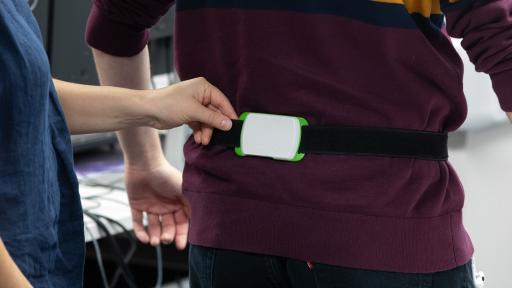
The research team are asking people with progressive MS who are already taking part in the national Octopus clinical trial to join this additional study and will evaluate their walking. This involves six monthly at-home remote mobility monitoring and in-clinic instrumented walking gait tests using a wearable sensor worn on the lower back. This trial will run alongside the Octopus study and takes place at Sheffield Teaching Hospitals NHS Foundation Trust and Leeds Teaching Hospitals Trust (led by Dr Linford Fernandes and Professor Helen Ford).
Octopus is a multi-arm and multi-stage (MAMS) trial for progressive MS that investigates potential treatments for slowing the progression of disability in participants with progressive MS. It is funded by the MS Society and takes place at several NHS hospital sites across the nation.
Developing tools that provide in depth information about how people with MS walk during everyday activities are important to measure how MS gets worse, the effect of treatments (e.g. physiotherapy, medicines) and whether a medicine studied in a clinical trial works. Asking people from such a large trial as Octopus provides a unique chance to explore whether DMOs can complement existing measures taken when people come to hospital. It also allows researchers to investigate whether the new treatments can slow or stop people with MS from becoming more disabled.
By measuring how well people with MS can walk in the real world, the team hopes to detect health changes earlier than existing tools can measure. This study has the potential to bring meaningful advancements in how we measure and think about MS and could help with understanding MS, developing new treatments, and potential cures.
Dr Gavin Brittain says,
"We know the symptoms for people with MS fluctuate and current tests measure walking in a standardised environment but can only provide a snapshot of a person’s capabilities. Mobility in the real-world, i.e. what people do in their normal day-to-day environment, is significantly more complex than this. It encompasses different environments, interactions with other people, multiple tasks, and social contexts. Taken together, this underscores the need for measuring mobility accurately in such real-world environments, to understand the impact that MS-induced changes have on an individual’s life.
"This potential improvement in the ability to accurately measure walking in people with MS will hopefully boost the chance of finding successful treatments for multiple sclerosis and will help doctors and people with MS accurately measure how well treatments are working for them."
If you would like to take part in the Octopus trial you can find out more information and register your interest via the UK MS Register.