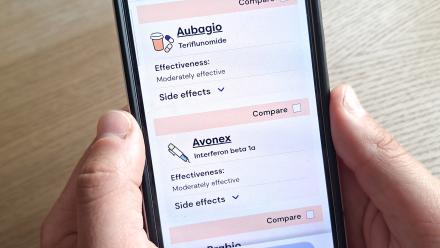
Beta interferon medicines (or interferon beta) are disease modifying therapies (DMTs) used to treat relapsing remitting multiple sclerosis (RRMS).
DMTs are treatments for people with multiple sclerosis (MS) that can help change the course of your MS by reducing the number of relapses and slowing down the buildup of disability in the long term.
You self-inject beta interferon medicines into a muscle or under the skin. They reduce the number of relapses you may have by about 30% and slow down disability progression.
There are three brands available on the NHS.
-
Avonex (interferon beta 1a)
-
Rebif (interferon beta 1a)
-
Plegridy (peginterferon beta 1a)
Other beta interferons called Betaferon and Extavia (interferon beta 1b) were offered in the past but are no longer available.
On this page we cover who can take beta interferons, how they work, their benefits and possible side effects.
Can I take a beta interferon (Avonex, Rebif, Plegridy) for my MS?
Disease modifying therapies (DMTs) are for people whose MS is considered active. This means you're experiencing relapses and/or you have new, active or enlarging lesions on an MRI scan.
Beta interferons are used for treating adults with active relapsing remitting multiple sclerosis (RRMS).
Further information on eligibility criteria for DMTs can be found in the treatment algorithm (NHS England) and in guidance from the Association of British Neurologists (BMJ).
Beta interferon medicines can only be prescribed by a neurologist.
How do beta interferons (Avonex, Rebif, Plegridy) work?
Interferons are proteins produced naturally by our body. They are released by white blood cells (part of the immune system) in response to infections.
Gamma interferon is released at the start of an immune response and encourages inflammation in the tissue under attack. Beta interferon is released at the end of an immune attack. It blocks the action of gamma interferon and helps to reduce inflammation and end the body's immune reaction.
Taking extra beta interferon in the form of one of these therapies calms inflammation throughout your body and reduces the immune response that is attacking the body’s own myelin.
Although beta interferons change your immune response, they are not thought to suppress the immune system or increase your risk of infections.
How effective are beta interferons (Avonex, Rebif, Plegridy) for treating MS?
The disease modifying therapies (DMTs) for treating relapsing remitting MS (RRMS) are grouped according to how effective they are (efficacy) at reducing the number of relapses you may have.
The therapies are described as:
- moderate efficacy therapies – reduce relapses by up to 50%
- higher efficacy therapies – reduce relapses by more than 50%.
Beta interferons are considered moderately effective therapies. In clinical trials, people taking Avonex, Rebif or Plegridy had about 30% fewer relapses than people taking placebo (a dummy medicine). MRI scans showed people taking these DMTs developed fewer new MS lesions over time. Beta interferons also slow down the build-up of disability associated with MS.
-
Avonex has been studied extensively since the early 1990s. It became available on the NHS in 2002. The following study first demonstrated the effectiveness of Avonex.
MSCRG Study: Multiple Sclerosis Collaborative Research Group Study – 1996 – Avonex compared to placebo
In this clinical trial, 301 people with relapsing remitting MS took either Avonex or placebo for two years. The main measure of the study was the time it took for participants to have an increase in disability of 1 point on the EDSS scale which lasted for at least 6 months. The group taking Avonex were significantly less likely to have this increase in disability. At the end of two years it was estimated that approximately 35% of those taking placebo and 22% of those taking Avonex had increased disability, a 37% reduction compared to placebo. Avonex reduced the relapse rate by 32% compared to placebo and also reduced the number of brain lesions on MRI.
Read more about the MSCRG clinical trial (PubMed).
The following study looked at the long-term effect of taking a beta interferon on disability progression.
Risk Sharing Scheme – 2018 – long-term effectiveness of beta interferons and Copaxone
This study was set up in 2002 to evaluate the long-term benefits of beta interferons and glatiramer acetate (Copaxone). More than 5,000 people taking either Avonex, Betaferon, Copaxone or Rebif were recruited at study centres around the UK and their disability levels (EDSS) monitored for 10 years. At the end of the study, changes in disability levels were compared to those recorded from an untreated group. The study found that the DMDs delayed the need to use a walking stick (EDSS 6.0) by four years.
Read more about the clinical trial results of the Risk Sharing Scheme (PubMed).
-
Rebif has been studied extensively since the early 1990s. It became available on the NHS in 2002. The following study first demonstrated the effectiveness of Rebif.
PRISMS – 1998 – Rebif compared to placebo
This clinical trial compared Rebif with placebo in 533 people with relapsing remitting MS. Compared with placebo, Rebif reduced the relapse rate by 27% to 33% over the two-year study. It also reduced the severity of any relapses that did occur. Rebif delayed the progression of disability, and a larger proportion of people were relapse-free with treatment compared to placebo. A separate report on MRI results found that Rebif reduced the number of brain lesions compared to placebo.
Read more about the PRISMS clinical trial (PubMed).
The following study looked at the long-term effect of taking a beta interferon on disability progression.
Risk Sharing Scheme – 2018 – long-term effectiveness of beta interferons and Copaxone
This study was set up in 2002 to evaluate the long-term benefits of beta interferons and Copaxone (glatiramer acetate). More than 5,000 people taking either Avonex, Betaferon, Copaxone or Rebif were recruited at study centres around the UK and their disability levels (EDSS) monitored for 10 years. At the end of the study, changes in disability levels were compared to those recorded from an untreated group. The study found that the DMDs delayed the need to use a walking stick (EDSS 6.0) by four years.
Read more about the clinical trial results of the Risk Sharing Scheme (PubMed).
-
Plegridy became available on the NHS in 2015. One large study has provided evidence to support the approval of Plegridy for multiple sclerosis.
ADVANCE – 2014 – Plegridy compared to placebo
This two-year study compared Plegridy taken by injection once every two weeks or once every four weeks with placebo in 1,512 people. At the end of the first year, Plegridy reduced the relapse rate by 35.6% in the fortnightly dosing group compared to placebo. Plegridy also reduced the number of brain lesions on MRI and the risk of worsening disability.
Read more about the ADVANCE clinical trial (PubMed).
We have more information on how DMTs are developed.
Who can and cannot take a beta interferon (Avonex, Rebif, Plegridy)?
It's important that you tell your MS team if you have any health problems or are taking other medicines.
A beta interferon may not be suitable for you if you have depression or suicidal thoughts.
You may need to be monitored more closely while taking a beta interferon if you have:
- epilepsy
- kidney or liver problems
- low white blood cells or platelets
- heart problems
- thyroid problems
- irritation at an injection site.
Beta interferons and conception, pregnancy and breastfeeding
If you're considering taking a beta interferon or any other disease modifying therapy (DMT), your MS team will proactively discuss family planning and the possibility of pregnancy with you where appropriate.
A beta interferon can be taken during pregnancy if your MS team thinks it’s needed to manage your MS. Beta interferons can also be used during breastfeeding. Research has shown no safety concerns to mother or baby when taking a beta interferon during these times. They are also considered safe to take while trying to conceive.
Women usually experience fewer relapses during pregnancy, so continuing to take a beta interferon may not be necessary. However, if a beta interferon is stopped during pregnancy, it will take several months to reach full effectiveness when restarted and may not reduce relapses during the first few months after childbirth.
Talk to your MS team as soon as you start thinking about having a baby. If you are trying for a family or you are pregnant, speak to your MS team about whether you should continue to take a beta interferon during pregnancy. They’ll likely consider how active your MS has been and talk you through any risks and benefits to help you make an informed decision.
We have general information about starting a DMT and things to consider.
Tests before starting a beta interferon
Before starting a beta interferon, you will have blood tests to measure your blood cell counts as well as your thyroid and kidney function. Liver blood tests (British Liver Trust) will be done to check your liver function. You will also usually have an MRI scan.
How do I take a beta interferon (Avonex, Rebif, Plegridy)?
The beta interferon medicines are taken differently depending on the brand.
- Avonex – You self-inject into a muscle once a week.
- Rebif – You self-inject under the skin three times a week.
- Plegridy – You self-inject under the skin or into a muscle (depending on injection device) once every two weeks.
These medicines should be taken at the same time, on the same day(s) each week.
All three medicines can be supplied in different forms, for example pre-filled auto-injection pens or pre-filled syringes. Your MS nurse can explain the different injection devices and help you choose the most appropriate one for you.
Your MS nurse will show you how to inject, discuss the practicalities and offer advice or training and ongoing support if you need it.
To give your body a chance to get used to beta interferon and reduce the impact of side effects, such as flu-like symptoms, your MS team may suggest you start on a lower dose which is increased gradually.
Beta interferon medicines should be stored in the fridge.
Stopping a beta interferon
You should not stop taking a beta interferon without discussing it with your neurologist.
Side effects of beta interferons (Avonex, Rebif, Plegridy)
All medicines, including disease modifying therapies (DMTs), can potentially cause side effects.
Some people may not experience side effects from taking a beta interferon. Some may find that any side effects ease after the first month or two as their body adapts to the medicine. For others, side effects may persist.
Your MS team will discuss potential side effects of the treatment with you and help you understand your risk. They will also tell you how to manage and report any side effects.
Very common side effects (may affect more than 1 in 10 people) of beta interferon medicines include:
- flu-like symptoms – headache, fever, chills and fatigue
- headache
- redness, itching or pain around the place you’ve injected (injection site reactions).
Flu-like symptoms are more common when you first start taking a beta interferon and tend to reduce with continued treatment. Your MS team may suggest ways to reduce these symptoms, such as:
- changing the time of day you inject so you sleep through any side effects
- taking paracetamol or ibuprofen half an hour before your injection and continuing it for up to a day afterwards
- drinking plenty of water if you have a fever to keep you hydrated.
Common side effects (may affect up to 1 in 10 people) of beta interferon medicines include:
For a full list of side effects, see the Patient Information Leaflets for each of the beta interferons.
You can report side effects through the Yellow Card scheme. Reporting side effects can make a big difference to other people using the same medicine as you.
Can I have vaccinations while on a beta interferon (Avonex, Rebif, Plegridy)?
People with MS are generally encouraged to have vaccinations which are part of the national vaccinations programme (NHS.UK vaccinations). Where possible, your MS team will advise you to get relevant vaccinations before you start taking a disease modifying therapy (DMT).
Beta interferons are not thought to affect the way your body responds to vaccination. People taking beta interferons can have live and inactivated vaccines when needed.
Monitoring while on a beta interferon (Avonex, Rebif, Plegridy)
Once you've started treatment, you'll have blood tests to measure blood cell counts and monitor liver function. These are done regularly for the first year, then less frequently (usually every 6–12 months). Your thyroid gland, kidney function and blood pressure may be checked during treatment too. Depending on local practice, the tests may be carried out at a local GP surgery, or it may be necessary to go to a hospital clinic.
You will likely have regular MRI scans to check your disease modifying therapy (DMT) is working effectively. Your neurologist will advise how often you should have one. They may recommend having an MRI scan three to six months after starting treatment, then once a year after this to check for MS activity. However, the frequency can vary between MS teams and MRI scans may be done less often than this.
Patient Information Leaflets for other formats available on EMC website.
-
National Institute for Health and Care Excellence (NICE).
Beta interferons and glatiramer acetate for treating multiple sclerosis.
NICE technology appraisal guidance TA527 (June 2018).
Full guideline (link is external)
National Institute for Health and Care Excellence (NICE).
Peginterferon beta-1a for treating relapsing–remitting multiple sclerosis.
NICE technology appraisal guidance TA624 (February 2020).
Full guideline (link is external)
Jacobs LD, et al.
Intramuscular interferon beta-1a for disease progression in relapsing multiple sclerosis. The Multiple Sclerosis Collaborative Research Group (MSCRG).
Annals of Neurology 1996;39:285–94.
Summary (link is external)
Palace J, et al.
Assessing the long-term effectiveness of interferon-beta and glatiramer acetate in multiple sclerosis: final 10-year results from the UK multiple sclerosis risk-sharing scheme.
Journal Neurology and Neurosurgery Psychiatry 2019;90(3):251–260.
Full article (link is external)
Ebers G.
Randomised double-blind placebo-controlled study of interferon beta-1a in relapsing/remitting multiple sclerosis. PRISMS (Prevention of Relapses and Disability by Interferon beta-1a Subcutaneously in Multiple Sclerosis) Study Group.
Lancet 1998;352(9139):1498–504.
Summary (link is external)
Li DK, et al.
Magnetic resonance imaging results of the PRISMS trial: a randomized, double-blind, placebo-controlled study of interferon-beta1a in relapsing-remitting multiple sclerosis.
Annals of Neurology 1999;46(2):197–206.
Summary (link is external)
Calabresi PA, et al.
Pegylated interferon β-1a for relapsing-remitting multiple sclerosis (ADVANCE): a randomised, phase 3, double-blind study.
Lancet Neurology 2014;13:657–65.
Summary (link is external)
Kieseier BC, et al.
Peginterferon beta-1a in multiple sclerosis: 2-year results from ADVANCE.
Multiple Sclerosis 2015;21(8):1025–1035.
Full article (link is external)
Rashid W, et al.
Using disease-modifying treatments in multiple sclerosis: Association of British Neurologists (ABN) 2024 guidance.
Practical Neurology 2025;25(1):18–24.
Full article (link is external)
Wijnands JMA, et al.
Disease-modifying drugs for multiple sclerosis and infection risk: a cohort study.
Journal of Neurology, Neurosurgery and Psychiatry 2018;89(10):1050–1056.
Summary (link is external)
Mullan G, et al.
UK consensus on pregnancy in multiple sclerosis: An update to 'Association of British Neurologists' guidance.
Multiple Sclerosis Journal 2026;32(9):885–896.
Full article (link is external)
Hellwig K, et al.
Pregnancy outcomes in interferon-beta-exposed patients with multiple sclerosis: results from the European Interferon-beta Pregnancy Registry.
Journal of Neurology 2020;267(6):1715–1723.
Full article (link is external)
Bast N, et al.
Impact of disease-modifying therapies on pregnancy outcomes in multiple sclerosis: a prospective cohort study from the German multiple sclerosis and pregnancy registry.
Lancet Regional Health Europe 2024;48:101137.
Full article (link is external)
Klehmet J, et al.
Impact of interferon beta exposure on birth outcome and child development - Results from the post-authorisation safety study PRIMA.
Multiple Sclerosis and Related Disorders 2023;77:104844.
Full article (link is external)
Houtchens M, et al.
Peginterferon beta-1a concentrations in breast milk of lactating multiple sclerosis patients.
Multiple Sclerosis and Related Disorders 2022;60:103700.
Summary (link is external)
Otero-Romero S, et al.
ECTRIMS/EAN consensus on vaccination in people with multiple sclerosis: Improving immunization strategies in the era of highly active immunotherapeutic drugs.
Multiple Sclerosis 2023;29(8):904–925.
Full article (link is external)
This information has been developed by the MS Trust Health Information team. Our team produces accurate evidence-based information to help you navigate your every day – working alongside health professionals. We would like to thank the following health professionals for checking the clinical accuracy of this information:
- Floriana De Angelis, Consultant Neurologist, Bedfordshire Hospitals NHS Foundation Trust and University College London Hospitals NHS Foundation Trust, and Clinical Research Associate, UCL Queen Square Institute of Neurology
- Stavroula Charisi, MS Specialist Pharmacist, University Hospital Southampton NHS Foundation Trust
- Laura Carrington, MS Clinical Nurse Specialist, Leeds Teaching Hospital NHS Trust.