
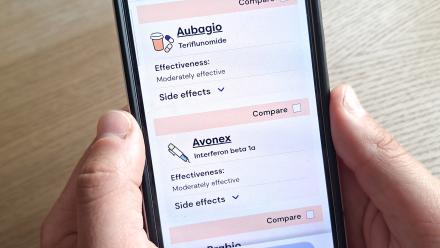
Compare disease modifying drugs (DMDs)
Compare the different types of disease modifying drugs (DMDs) that are available to treat multiple sclerosis (MS).
Fingolimod is a disease modifying therapy (DMT) for treating highly active relapsing remitting MS. Its original brand name is Gilenya. There are now several generic options available on the NHS.
Disease modifying therapies (DMTs) are treatments for people with multiple sclerosis (MS) that can help change the course of your MS by reducing the number of relapses and slowing down the buildup of disability in the long term.
Fingolimod is available as a pill that is taken once a day. It reduces relapses by at least 48%.
On this page, we look at who can take fingolimod, how it works, its benefits and possible side effects.
Fingolimod is used for treating highly active relapsing remitting MS in the UK.
Relapsing remitting MS (RRMS) is considered highly active if you continue to have relapses despite treatment with another DMT.
Fingolimod may also be recommended for you if you have what is considered rapidly evolving severe (RES) relapsing remitting MS. This is if you have had two or more disabling relapses in one year and MRI evidence of new areas of MS activity. NHS England has more information about what is considered a disabling relapse (PDF, 685KB).
It is licensed and approved for use by adults and for children over the age of 10 in the UK. Fingolimod can only be prescribed by a neurologist.
We have information about other DMTs for treating relapsing remitting MS and progressive MS.
Fingolimod helps to protect your brain and spinal cord (central nervous system) against attacks from the immune system. It does this by reducing the ability of some white blood cells (lymphocytes) to move freely within the body, stopping them from reaching the brain and spinal cord. This limits nerve damage caused by MS.
White blood cells help your body fight infections. Because fingolimod reduces their ability to move freely, it affects some of your body’s immune responses, increasing your risk of infections.
While disease modifying therapies (DMTs) cannot cure MS, they have several benefits, such as reducing the number of relapses you may have.
The DMTs for treating relapsing remitting MS (RRMS) on the NHS are grouped according to how effective they are (efficacy) at reducing the number of relapses you may have.
The therapies are described as moderate efficacy therapies or higher efficacy therapies. Higher efficacy therapies are those that are known to reduce relapses by more than 50%.
Fingolimod is considered a moderately effective therapy. In clinical trials, fingolimod has been shown to reduce relapses by at least 48% compared to a placebo (dummy medicine). MRI scans have also shown that people taking fingolimod had fewer, smaller or no new areas of active MS (lesions).
There is some evidence that fingolimod can slow down disability progression over the long term.
We have information about the benefits of DMTs.
We also have more information about fingolimod research. We also have information about how new drugs are developed.
Evidence for the effectiveness of fingolimod in relapsing remitting MS has come from large clinical trials.
This two-year study compared fingolimod and placebo in 1,272 people with relapsing remitting MS. Compared to placebo, fingolimod reduced the relapse rate by 54% to 60%. Fingolimod also reduced the risk of worsening disability by about 30% compared to placebo.
This two-year study, conducted predominantly in the USA, compared fingolimod and placebo in 1,083 people with relapsing remitting MS. Compared to placebo, fingolimod reduced the relapse rate by 48%. There was no significant difference in the worsening of disability between any of the groups.
You can find out more about the trial from The New England Journal of Medicine.
TRANSFORMS was a one-year study, comparing fingolimod with Avonex in 1,292 people with relapsing remitting MS. Compared to Avonex, fingolimod reduced the relapse rates by between 38% to 52%. However, later analysis of the results showed that people with high disease activity experienced a 61% reduction in relapse rates. There was no significant difference in worsening of disability between the groups.
You can find out more about the study from the New England Journal of Medicine.
Paediatric MS
In this study, 215 participants with relapsing remitting MS aged 10-17 years, took either fingolimod or Avonex for up to two years.
Fingolimod reduced the relapse rate by 82% compared to Avonex. There were also significantly fewer new lesions seen on MRI scans of those taking Gilenya.
Side effects were slightly more frequent in the Avonex group (95.3%) than the fingolimod group (88.8%), but in the fingolimod group the rate of serious side effects was higher – 6.5% versus 16.8%, respectively.
You can find out more about the study from the National Library of Medicines.
Before you start taking fingolimod, your MS team will discuss the benefits and possible risks of the therapy with you.
Together, you will decide if the benefits outweigh any potential risks based on your individual circumstances. You will consider various factors. We have more information about starting a disease modifying therapy (DMT)..
Fingolimod is not suitable for some people. It is important that you tell your MS team if you have any health issues or are taking other medicines.
Fingolimod will not be recommended for you if you have certain health issues or conditions, such as:
Fingolimod will also not be recommended for you if you are taking or have recently taken medicines for an irregular heartbeat.
Other health issues your MS team may consider when deciding if fingolimod is suitable for you include:
If you have any of these and fingolimod is prescribed for you, you may need additional monitoring during treatment.
You can find out more about other health issues and medicines interactions to consider before you start taking fingolimod (EMC patient information leaflet).
Fingolimod can harm your unborn baby; therefore, it will not be recommended if you are considering having a baby.
The use of effective contraception is recommended while you are taking fingolimod.
If you’re considering taking fingolimod or any other disease modifying therapy (DMT), your MS team will proactively discuss family planning and the possibility of pregnancy with you where appropriate.
If you are already taking fingolimod and you start considering pregnancy, your MS team will discuss with you what’s best for you. They are likely to recommend that you stop taking fingolimod and continue using effective contraception for 2 months after you stop taking it. This is to ensure that blood levels of the therapy are low enough for it to be safe to become pregnant. You may hear this referred to as a washout period.
Your MS team will also discuss with you what treatment may be best for you when you stop taking fingolimod.
If you become pregnant when taking fingolimod, tell your MS team straight away. Your treatment with fingolimod will be stopped, and your MS team will refer you to a pregnancy specialist for monitoring. They will also discuss with you what treatment may be best for you when you stop taking fingolimod.
Fingolimod is not recommended for women who are breastfeeding.
Where appropriate, you will be given a pregnancy-specific patient reminder card (EMC) when you start taking fingolimod.
We have general information about starting a DMT and things to consider.
Before starting fingolimod, you will have tests to determine if it's suitable for you. These include:
If you have a pre-existing health condition which affects the eye, such as diabetes (NHS UK), you may also have an eye examination.
If you are not protected against chickenpox, you may need a vaccination before you start taking fingolimod.
You take fingolimod as a pill, once daily.
You will have your first dose of fingolimod in a hospital or an outpatient clinic. Your doctor will usually ask you to stay at the hospital or clinic for 6 hours. Some people may need to stay for longer, and some may need to stay overnight.
This is so that you are monitored for any potential temporary side effects until they resolve. Fingolimod is known to cause temporary changes, such as a low heart rate and changes to your blood pressure.
Your pulse and blood pressure will be checked every hour during this period. You will also be monitored using an electrocardiogram ECG (NHS UK).
You will usually be monitored in the same way if your treatment is stopped and restarted for any reason for certain periods after you start taking fingolimod.
Unless there are problems that require further monitoring after the first dose, you will be able to take fingolimod without supervision at home.
You should not stop taking fingolimod (Gilenya) without discussing it with your neurologist, as your MS may become more active after stopping fingolimod. You may hear this referred to as the rebound effect.
If fingolimod is no longer the right treatment for you, your MS team will work with you to plan a safe way to stop taking it. They will also work with you to find an alternative treatment.
All medicines, including disease modifying therapies (DMTs), can potentially cause side effects.
Some people may not experience side effects from taking a DMT. Some may find that any side effects ease after the first month or two as their body adapts to the medicine. For others, side effects may persist.
Your MS team will discuss potential side effects of the treatment with you and help you understand your risk. They will also tell you how to manage and report any side effects.
Very common side effects (may affect more than 1 in 10 people) of fingolimod include:
Common side effects (may affect up to 1 in 10 people)
Other side effects can include:
Cases of skin cancers, such as basal cell carcinoma (NHS UK), have been reported in people taking fingolimod. Your MS team will tell you what skin changes to look out for before you start taking fingolimod and how to report them. They will also talk to you about precautions to take, such as protecting your skin, and you will be monitored for changes while taking fingolimod
Cases of a rare but serious brain infection called progressive multifocal leukoencephalopathy (PML) have been reported in some people taking fingolimod. Your MS team will help you understand your risk before you start taking fingolimod. If you are at increased risk of developing PML, you will be routinely monitored for signs and symptoms.
Early signs and symptoms of PML can be like an MS relapse. It is important to tell your MS team straight away if you notice new or worsening symptoms of your MS.
If you are worried about side effects before and during treatment, you should tell your MS team straight away. You can also speak to a pharmacist if you have concerns.
You will also be regularly monitored when taking fingolimod.
A full list of side effects is included in the manufacturer's Patient Information Leaflet (PIL) (EMC).
You can also report side effects through the Yellow Card scheme (MHRA). Reporting side effects can make a big difference to other people using the same medicine as you.
People with MS are generally encouraged to have vaccinations which are part national vaccinations programme (NHS UK vaccinations). Where possible, your MS team will advise you to get relevant vaccinations before you start taking a disease modifying therapy (DMT).
Because fingolimod suppresses your immune system, increasing your risk of infection, live vaccines will not be recommended for you. Live vaccines such as the yellow fever vaccine should be avoided.
We have more information about vaccination and immunisation.
You will usually have routine reviews to check that fingolimod is effective and suitable for you once you start treatment.
These checks will include some of the following at different intervals:
This information has been developed by the MS Trust Health Information team. Our team produces accurate evidence-based information to help you navigate your every day – working alongside health professionals. We would like to thank the following health professionals for checking the clinical accuracy of this information: