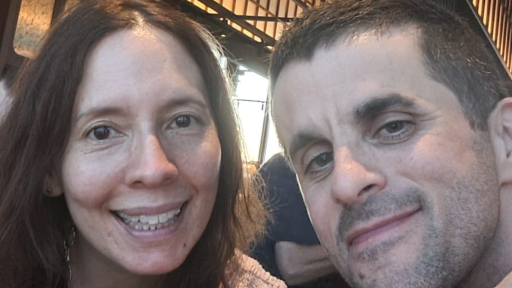
At just 19, Katie began experiencing symptoms that she couldn’t explain. Years later, after a long journey to diagnosis, she learned that they were caused by multiple sclerosis (MS). Katie shares how vertigo affects her daily life, the challenges of navigating uncertainty, and how MS Trust has helped her navigate her MS journey.
When something didn't feel right
I can specifically remember a night in July 2024 when I first experienced a burning hot sensation in both my feet, and it was so intense that it interrupted my sleep. I decided to stand in the shower and run the cold water over my feet for around 20 minutes before it started to ease.
The next morning, I awoke to complete numbness of my feet which left me extremely worried as I had never experienced anything so severe as this.
Prior to this, I had experienced a range of symptoms which I admit to brushing off, including severe dizziness (later diagnosed as vertigo), being unable to get my words out, forgetfulness and falls. I had also experienced altered sensations such as, tingling and pins and needles in my feet and hands. However, nothing as severe as complete numbness of my feet.
Receiving my MS diagnosis
The journey to my MS diagnosis was long and tedious. I was given multiple different answers as to what doctors thought were causing my symptoms, such as vitamin B12 and vitamin D deficiency and migraines.
Although MS had been mentioned as a possibility a few times before my diagnosis, hearing the words officially confirmed made me feel both uncertain but relief at knowing I finally had answers.
I feel like the gravity of the diagnosis and what it meant for me and my future only hit me when I chose my preferred treatment option and started it.
The reality of living with vertigo
Before my MS diagnosis, I never realised that vertigo could be linked to MS. I’m able to remember when I first experienced vertigo back in 2019. I was at work at the time and it came on suddenly and made me instantly feel sick whilst filling me with an awful sense of anxiety trying to understand why I felt so unwell. Perhaps part of the anxiety was due to not understanding what the experience was and had I been better equipped to know how to recognise vertigo, I might have felt less anxious.
When I first experienced vertigo, I felt anxious. I was convinced that something was seriously wrong.
I find that vertigo comes on suddenly for me with a wave of severe dizziness and leads to nausea and sometimes vomiting. To settle it, if I can, I try to lie down the first chance I get as that seems to settle the dizziness, and any sort of movement worsens my vertigo. Previously, I have experienced difficulties with balance, unsteadiness and walking in a straight line. Personally, my most severe vertigo episodes can last from a few hours up to a few days. I can still experience milder spells of dizziness which can affect my balance for a few minutes before subsiding again.
I can remember going to an urgent care centre once with severe vertigo and I couldn’t even circle my gender on the sign-in form as my vision was affected.
I found out that my vertigo was related to my MS due to the locations of some of my lesions on my brain, which makes me feel less anxious when I experience it, knowing it has an explanation. Luckily, I have had a good experience with both GPs and my MS nurses when discussing vertigo, as they were helpful.
How vertigo affects my daily life
Unfortunately, I have found that when I am feeling more fatigued, I am more likely to experience episodes of vertigo. I try to minimise my activity when experiencing a severe bout of vertigo for example, I avoid driving and using kitchen appliances, until I feel safer to do so.
As my experience of vertigo can be so sudden and unpredictable, much like many other MS symptoms, I find it’s an anxiety inducing symptom and makes me feel quite vulnerable to socialising for example. I often worry about experiencing an episode when I’m out with friends or away from home, it makes me think twice about plans.
Finding ways to manage my vertigo
I try to live my life in a way that benefits my MS and my symptoms. For example, to try and reduce the risk of an episode of vertigo I try to stay hydrated, I try to get good quality sleep and move slowly when it comes to head movements. As, I have found my triggers to vertigo can be fatigue, stress or dehydration.
How MS Trust has helped me feel less alone
MS Trust was one of the first places I turned to when MS was first mentioned as a possible diagnosis. Since then, it has become the first place I send people when they ask me about MS and how to learn more about it. Often people struggle to wrap their heads around it and yet the information on MS Trust’s website has helped them understand what life with MS is really like.
I have often used the website to research different aspects of my MS. For example, I was scared to choose a long-term medication, and the DMT decision tool really helped me to establish what treatment to choose based on my personal lifestyle and my MS.
Looking forward
I feel that it’s important to acknowledge that having an MS diagnosis does change the way you view your life, but it’s even more important to recognise that you are still you.
You can still laugh until your belly hurts. You can still fall in love, travel the world, make impulsive decisions, go on adventures, and plan a future that you want and can look forward to. Some days MS will take up a whole page of your story; other days it will be just a sentence.
Why am I dizzy? : In this episode of MS Trust Podcast, Helena talks to Dr Rachel Dennett, physiotherapist, researcher and Lecturer in Physiotherapy at the University of Plymouth, about the causes of dizziness, vertigo and balance problems in MS.
Keep up-to-date with the latest MS news, explore new research, read the stories of people living with MS, find out practical tips from MS experts, and discover exciting fundraising opportunities
If you would like to sign up for post or telephone (SMS) updates you can complete our sign up form here